
The 2026 Marketing Reality Check
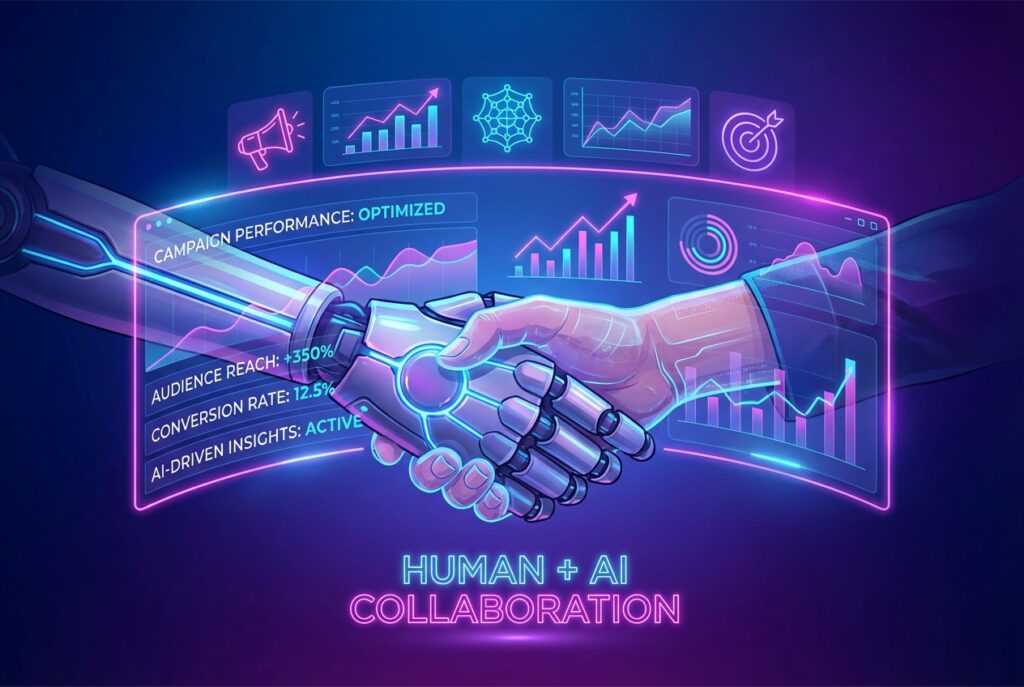
The holy grail of marketing hasn’t changed. It’s still about getting the right message in front of the right eyeballs at exactly the right second. But let’s be honest about 2026: the way we actually pull that off has completely mutated.
We used to treat AI like an eager intern—good for drafting a quick email, brainstorming hooks, or summarizing a messy spreadsheet. Not anymore. It’s off the leash now, stepping out of the “assistant” zone and into the driver’s seat.
From “Intern” to “Operator”
We’re dealing with what people are calling agentic systems, and they honestly just do the work. These setups don’t sit there blinking at a cursor, waiting for you to hit enter. They actually run the show.
- They launch the campaigns.
- They kill the losing ad sets and double down on the winners.
- They tweak the targeting on the fly.
And they do it entirely on their own, without you having to babysit a dashboard.
If you think this is just buzzword bingo from a tech conference PowerPoint, look around. Tiny, bootstrapped startups are outmaneuvering massive agencies by letting these agents handle the heavy lifting. Stuff that used to eat up three weeks of messy Slack threads and manual A/B testing? It’s getting knocked out by Tuesday afternoon.
What This Actually Means for Us
So, what do we actually do all day now? We get to be marketers again.
Instead of drowning in repetitive tasks or obsessing over bid caps, we finally have the breathing room to focus on what actually matters: psychology, killer creative, and figuring out how to genuinely connect with people.
But you can’t just look the other way and hope your 2023 playbooks still hold up. The gap between the brands leaning into this and the ones dragging their feet is getting ugly. The early adopters are iterating at a pace that is frankly impossible to compete with if you’re still doing everything manually.
The Bottom Line
Your job isn’t disappearing. It’s getting a massive upgrade. Figuring out how to co-pilot these agents is basically the only skill that matters right now if you plan on being relevant in the next five years.
Cutting the Jargon: What is an AI Agent?
People throw the phrase “AI agent” around a lot right now, making it sound way more complicated than it actually is.
At its core, an agent is just a piece of software given a specific job. But instead of following a rigid, coded set of rules—like old-school automation—it uses models like GPT, Claude, or Gemini to actually “think” through the task.
Think about your end-of-month reporting. Usually, you’re bouncing between three different dashboards, exporting CSVs, praying the numbers match up, and manually writing out the takeaways. It’s a grind.
An AI agent just does that for you. It logs in, pulls the data, verifies it, and drops a clean, formatted summary on your desk that is essentially 90% done. You just give it a quick read-through and hit send. It’s basically a hyper-focused junior team member who never needs a coffee break and can juggle five campaigns at once without dropping the ball.
The Death of the Traditional Funnel
We used to treat the customer journey like a neat, predictable highway. Someone sees a Facebook ad, clicks through, opens a few tabs to compare prices, and eventually buys.
That version of the internet is dying.
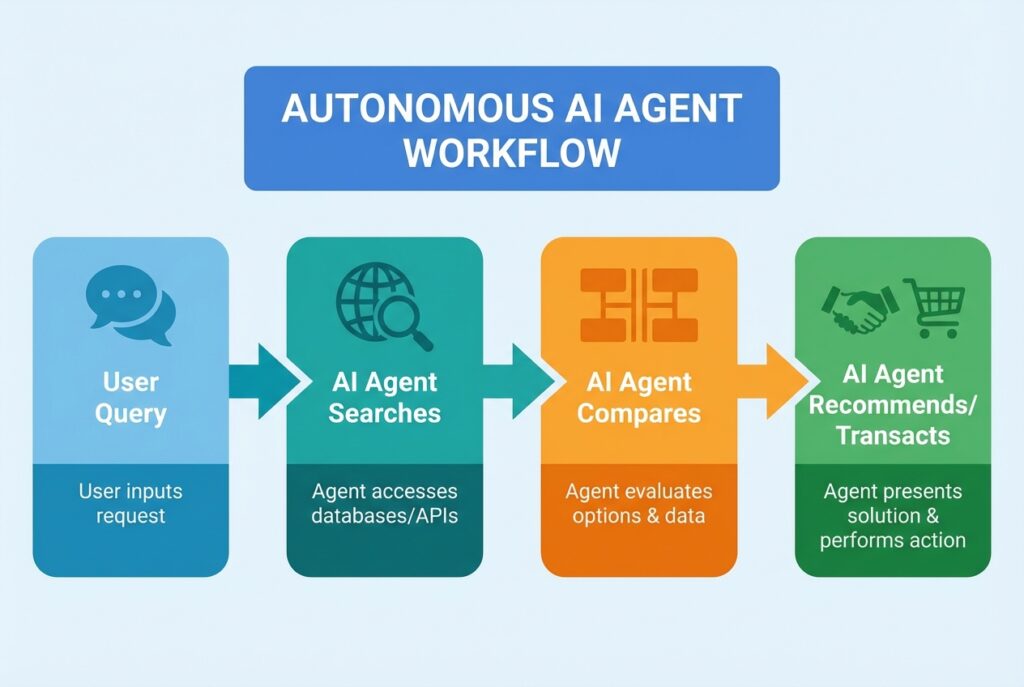
AI isn’t just sitting at the end of the funnel; it’s stepping in before the search even starts. People are changing how they look for things. Instead of typing “plumber near me” into a search bar and scrolling through ten websites, they’re telling their phone, “Find someone who can fix my kitchen sink by 3 PM today.”
Here is the terrifying part for brands: the AI isn’t giving them a list of links. It’s making the choice for them.
It scans the web, looks at reviews, checks credibility, and picks the best option. There is no scrolling. There is no “page two” of search results. If the AI doesn’t pick you, the customer literally never knows you exist.
The New Rules of the Game
This is happening faster than most businesses realize. A huge chunk of people are already treating AI like a personal concierge, delegating the annoying parts of shopping and booking services directly to the tech. They don’t want to search; they want an outcome.
The opportunity for massive growth is still there, but the playbook has completely flipped. Visibility isn’t just about outbidding your competitors on Google anymore. It’s about making sure your digital footprint, your data, and your reputation are so clean and authoritative that the AI trusts you enough to recommend you.
In 2026, you aren’t just trying to win over the human. You have to win over the machine first.
Where the Rubber Meets the Road: Real-World Use Cases
If you’re still thinking about AI agents as some “future tech” from a 2024 whitepaper, you’re already behind. In 2026, these systems aren’t just gadgets; they’re the silent engines running the marketing departments of brands that are actually winning.
Here’s what that looks like on the ground:
1. Campaigns That Run Themselves (Literally)
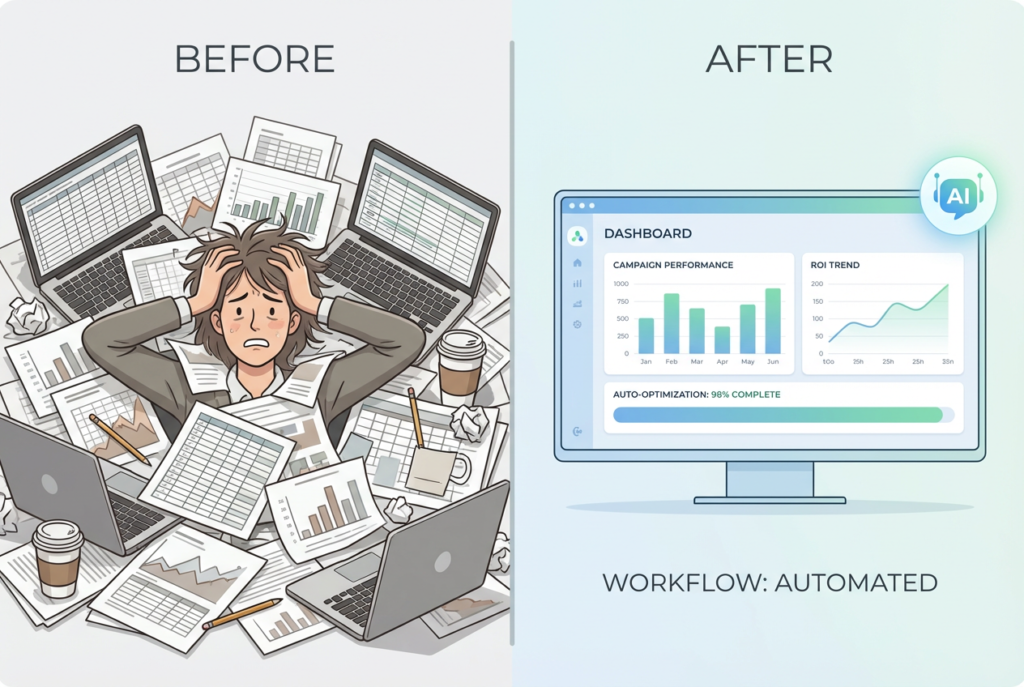
Remember the daily grind of logging into Meta or Google Ads to tweak bids and swap out underperforming creative? That’s becoming a relic of the past.
We’re seeing “agentic clusters” now—basically a tiny, digital team. One agent handles the bidding, another obsessively watches the audience segments, and a third swaps in fresh copy when the data starts to dip. They talk to each other through things like the Model Context Protocol (MCP), coordinating in real-time. You aren’t micromanaging clicks anymore; you’re just pointing the ship in the right direction.
2. The End of “Wait and See” Optimization
Old-school optimization was slow. You’d run an ad for a week, look at the wreckage, and try to fix it for the next round.
Now? Optimization is a heartbeat. These agents don’t wait for a weekly report. They see a trend shifting on a Tuesday morning and reallocate the budget by Tuesday lunch. It’s continuous, compounding improvements that happen while you’re asleep.
3. Support That Doesn’t Feel Like a Script
The “dumb” chatbot is dead. The 2026 version actually understands what a customer is asking. Whether it’s on WhatsApp or your site, these agents can qualify a lead, handle a complex product question, and hand off a high-value prospect to your sales team—vetted and ready to go. For a small team, this is the ultimate force multiplier. You suddenly have a 24/7 global sales floor.
4. SEO for the “Answer Engine” Age
We used to write for Google’s crawlers. Now, we’re writing for AI synthesizers. Agents are now helping us find the “content gaps” that competitors missed and structuring data so that when an AI assistant looks for an answer, yourbrand is the one it quotes.
The New Hierarchy: AI Decides, Humans Direct
This is the pill that’s hardest to swallow: In 2026, an AI will likely form an opinion about your brand before a human ever sees it.
By the time a customer interacts with you, an AI agent has already scanned your reviews, checked your authority, and decided if you’re even worth recommending. If your digital “vibe” is messy or your data is unstructured, you’re invisible.
Your marketing strategy now has two bosses:
- The Human: Who needs to be moved by your creativity and story.
- The Machine: Which needs clean, structured signals to trust you.
Your 2026 Survival Guide
Don’t panic, but don’t sit still either. Here’s how to actually stay in the game:
- Clean Up Your Data: Structure matters more than ever. If an AI can’t “read” your site easily (think FAQs and clear schema), you don’t exist.
- Fix Your Reputation: AI loves social proof. Reviews and mentions on high-authority sites are no longer just “nice to have”—they are the fuel that powers AI recommendations.
- Start Small: You don’t need to automate your whole company by Friday. Pick one annoying task—maybe it’s lead qualification or weekly reporting—and hand it off to an agent.